
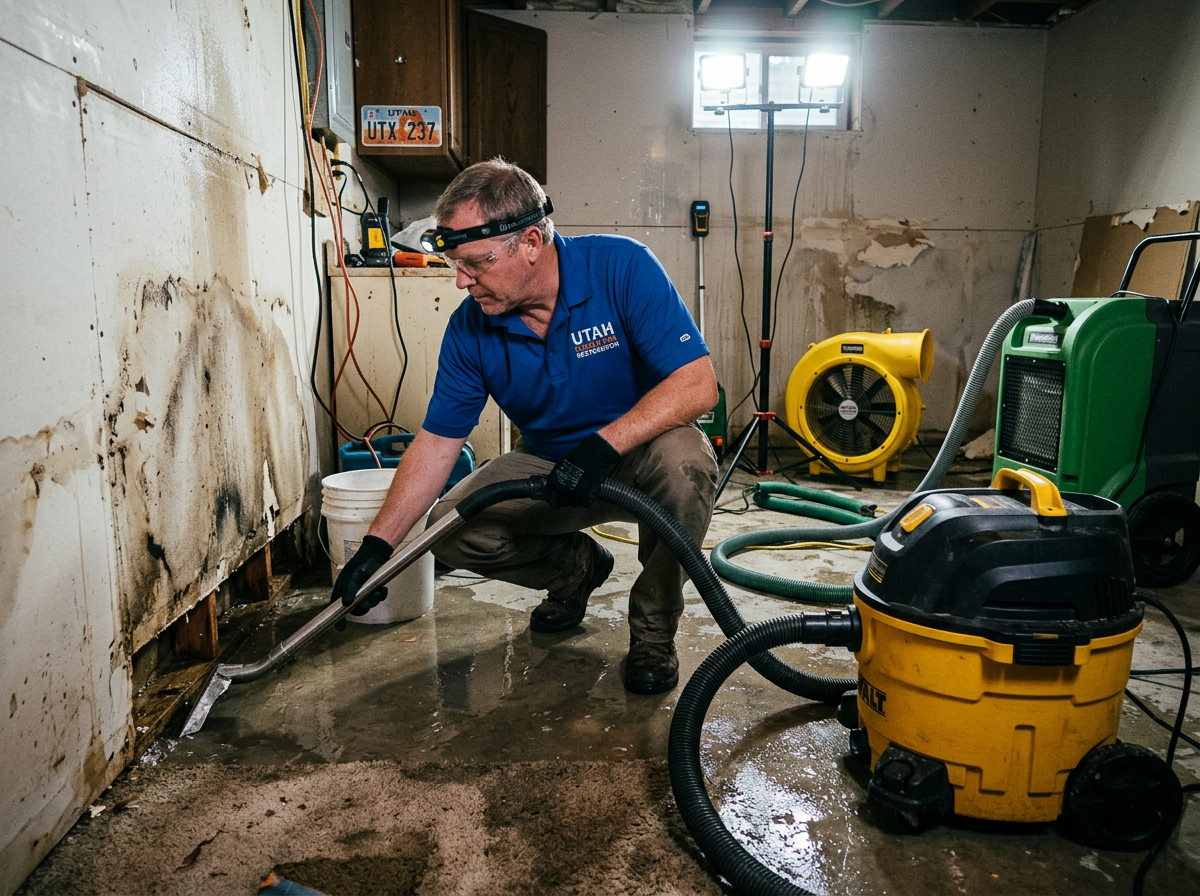
Heber City properties often feature timber-frame and log construction that holds both smoke and residual moisture. High elevation brings early and persistent cold that turns water into ice inside cavities.
Many homes sit empty for weeks or months, so crews check for hidden damage along US-40 corridors and in neighborhoods such as Lake Creek and North Village before full restoration begins.
Here's how our water damage restoration work runs in Heber City — the same standards we hold across Utah, delivered by the crew that covers Wasatch County.
Water Damage Restoration Services We Offer in Heber City
✓Suppression Water Extraction
Removes standing and trapped water from floors, walls, and attics immediately after fire department operations to prevent further migration into framing.
✓Frozen Cavity Water Removal
Cuts controlled access points and applies localized heat to thaw and extract ice trapped above 4,500 feet before expansion damages studs and sheathing.
✓Structural Drying and Dehumidification
Places air movers and dehumidifiers in a closed loop with the affected cavities while tracking daily moisture levels until wood returns to equilibrium.
✓Moisture Verification
Uses pin and pinless meters plus infrared imaging to confirm hidden water is gone before walls are closed, preventing callbacks from residual dampness.
✓Hidden Water Intrusion Assessment
Maps water paths through attics, soffits, and rim joists typical in Utah fire responses so no saturated insulation or sheathing is left behind.
Fire crews in Payson and surrounding foothills deliver thousands of gallons through walls and attics that then pool in crawl spaces and behind baseboards. Once winter temperatures drop, that water expands as it freezes inside cavities, pushing drywall seams apart and saturating insulation that never dries on its own. Technicians start by cutting strategic weep holes at the lowest points of each affected wall so gravity pulls the liquid out before heaters are introduced, because warming frozen material first turns it into more water that migrates deeper into the structure.
Dry Utah air evaporates surface moisture quickly, which hides the fact that joists and rim boards remain saturated for weeks. Skipping moisture mapping at this stage lets hidden pockets trigger mold weeks later, especially in older Payson homes with balloon framing that creates continuous pathways from foundation to roof. Extraction therefore always precedes drying; crews use negative-air machines to pull air through the cavities while logging moisture readings every twenty-four hours until studs and subfloors read within two percent of unaffected material.
How It Works in Heber City
- 1
Initial Assessment
Document water volume, affected assemblies, and current temperatures to determine whether freezing has already occurred in wall or attic cavities.
- 2
Extraction
Remove free water and create drainage paths so remaining liquid can exit before drying equipment is started.
- 3
Drying and Monitoring
Run equipment in a contained loop and record moisture readings daily until all structural members reach target levels.
- 4
Final Verification
Re-inspect with meters and imaging, then provide documentation of readings before any reconstruction begins.
Serving All of Heber City
We regularly handle water damage restoration jobs near:
- 📍Heber Valley Railroad
- 📍Jordanelle State Park
- 📍Wasatch Mountain State Park
- 📍Downtown Heber City
Water Damage Restoration Pricing in Heber City
Scope depends on water volume, number of affected stories, whether cavities have frozen, and access restrictions; call for inspection.
Want the full picture of this service? See our Water Damage Restoration page, or everything we do in Heber City, UT.